
Unimaginable
What happens when our limits lie within.....

I was talking the other day with a tech founder whose perspective on what he’s building, and where he’s investing, challenged how I think about what I teach, how I advise students and where I see obstacles to radical progress.
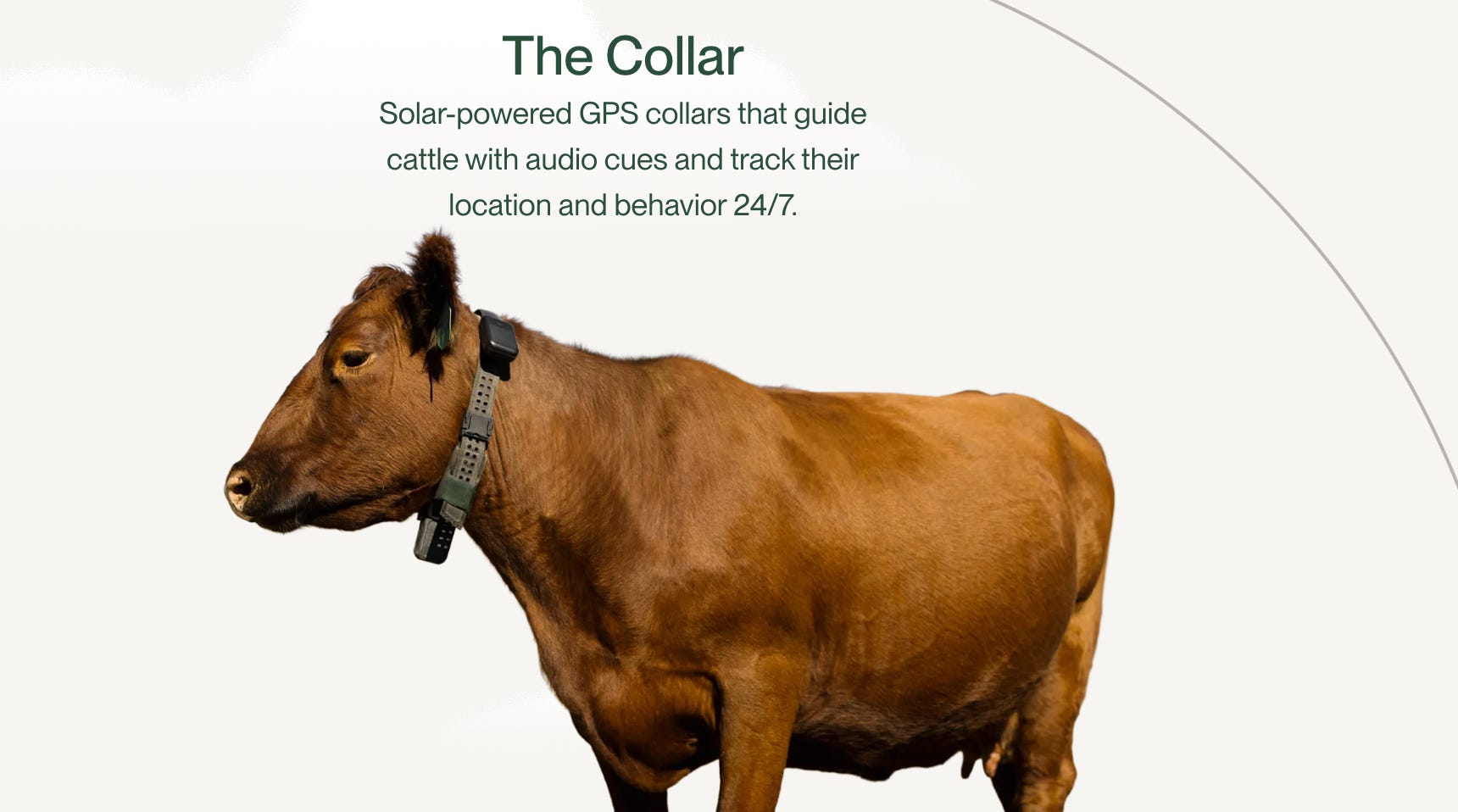
It all started with cow collars. Have a problem keeping your cows in your fields? You could erect fences…or you can use a satellite-linked cow collar, which works something like a geo locator plus dog fence plus oura ring, so you know where they are and how they’re feeling and can run your ranch from your phone.
(And yes. There’s a cowgorithm.)
We read every day about breakthroughs—predicting how proteins fold, solving mathematical mysteries, simulating 1000 years of climate in a day— but these are the province of high church science. What about small snarls of daily life? Track those pesky mosquitos with lasers; inventory your fridge and have it plan dinner; or use a bot to sell your house without a realtor.
In between the miraculous and the mundane are the challenges of shared civic space: traffic patterns and land use rules, health care access and public education. Students come to the Kennedy School determined to find solutions to the fiercest problems, build and implement them in communities all over the world. We have brilliant faculty who are experts in all manner of policy design and delivery. I’m just wondering what it will take to empower students, and rising leaders everywhere, to see around corners, color outside the lines, imagine a future that looks not just marginally but immeasurably different from the present.
“AI changes what problems are tractable,” said Stanford Astrophysicist Risa Wechsler at a recent AI conference, “but it doesn’t tell us what problems matter. ”
That’s the province of morals and meaning, judgment and decision-making, “soft skills” with hard edges. I tell aspiring journalists that I never took a journalism course; the most valuable subjects I studied long, long ago in college and graduate school were history, and philosophy.
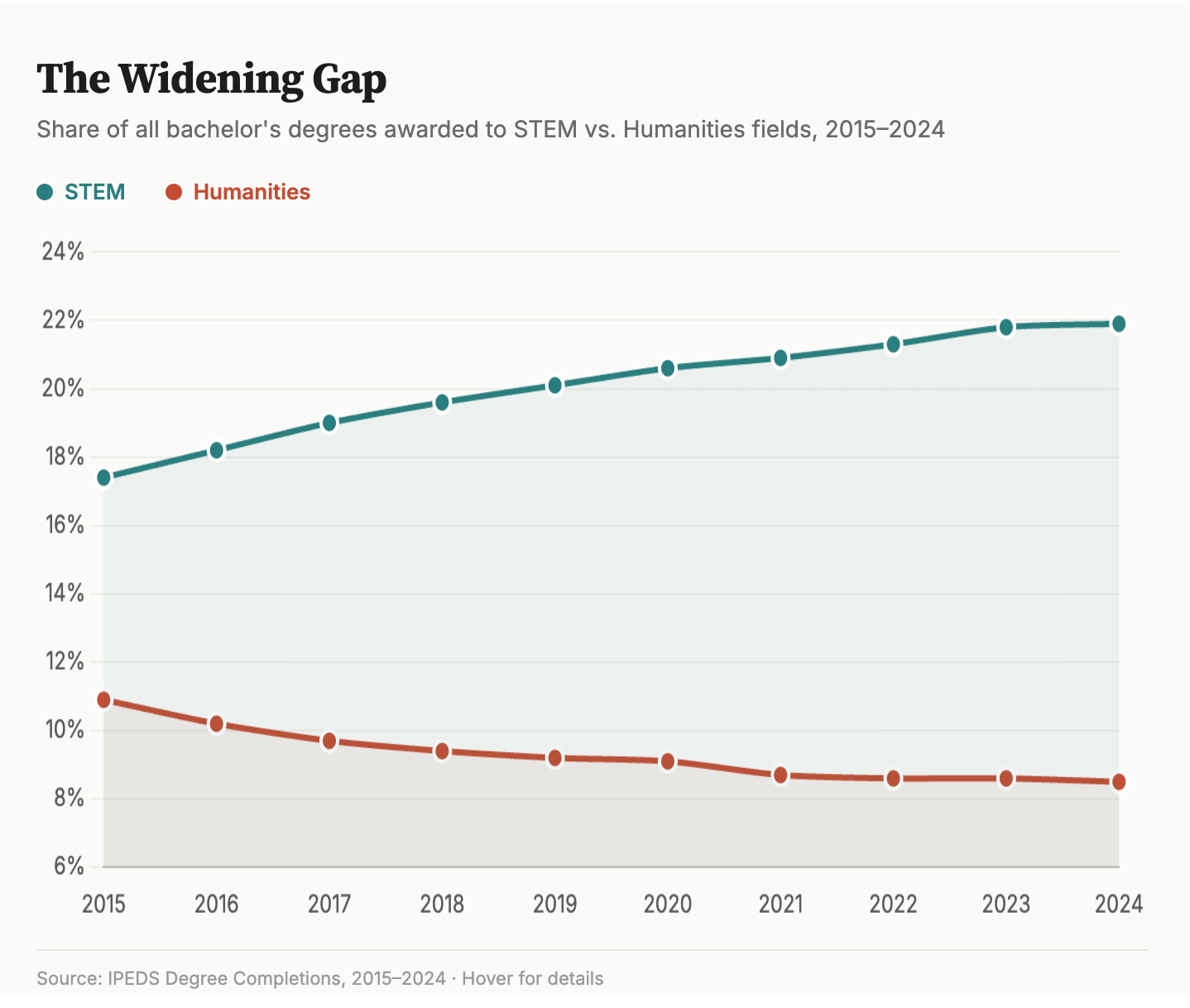
In the years since we’ve seen those departments, along with other humanities, hollowed out as students flock to STEM majors:
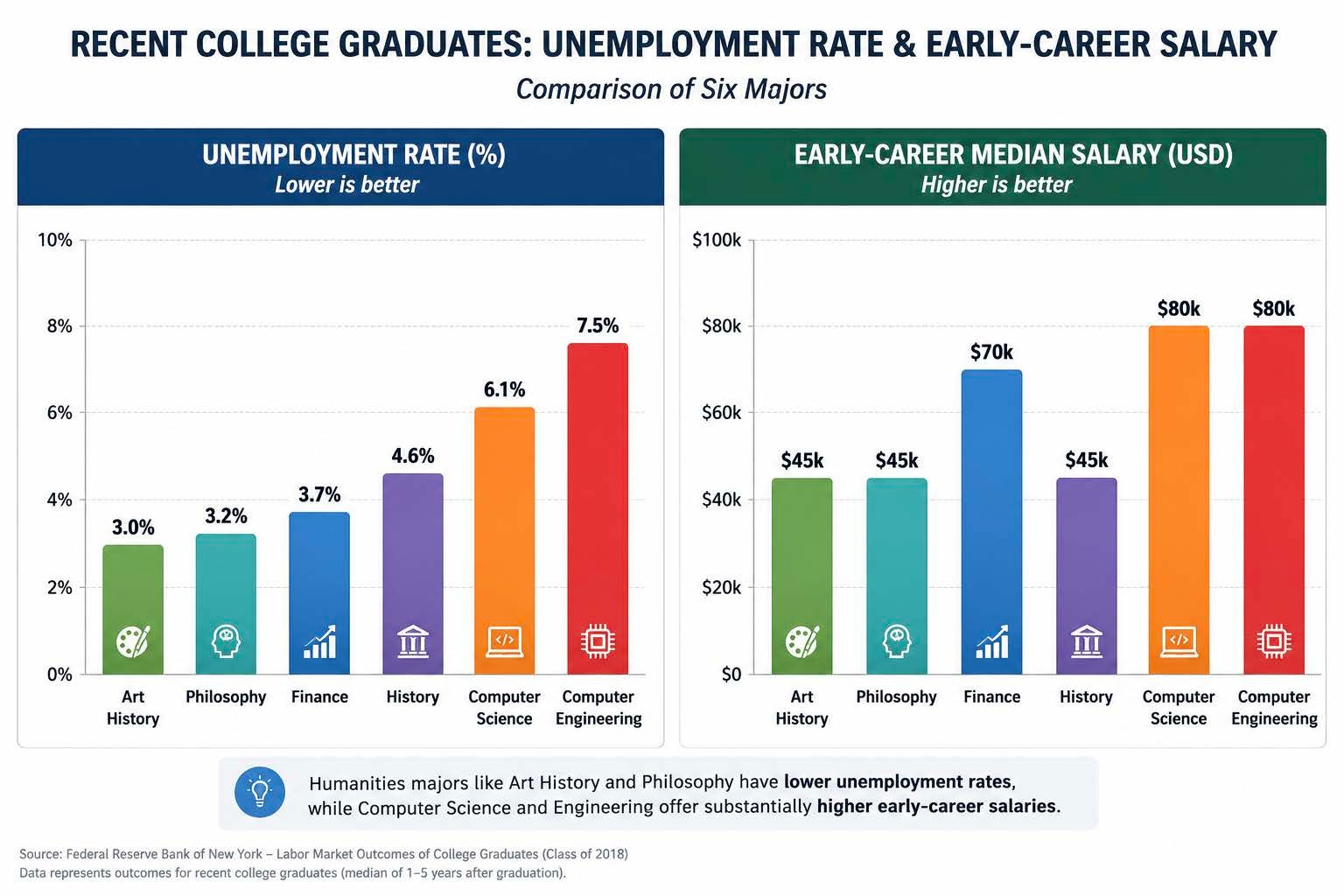
Now the Harvard Business Review publishes articles like Why Engineers Should Study Philosophy and in the New York Fed’s labor-market analysis of recent graduates, unemployment for computer science majors hovers above 6%—twice that of art history and philosophy majors. The engineers still earn more….if they can get hired in the first place. Which argues for the value of building fluency across multiple mental languages.
As a longtime fan of a broad liberal arts education, I’d cheer this on intellectual as well as instrumental grounds; but maybe it will slow the gutting of humanities departments if it becomes ever more clear that imagination, with its sturdy siblings empathy and curiosity, will be the key to success of all kinds.
None of this is new or groundbreaking–it just feels harder. How do we measure imaginative power, unconventional instincts, conceptual courage? What are the GRE questions that would assess inspiration alongside intelligence?
Before I ever thought about imagination as a writer or teacher, I worried about it as a parent. I’m writing this as I sit outside on a perfect Not-Quite-Summer-But-Might-As- Well-Be day, thinking about how critical these coming months are for building a whole different set of muscles.
I wrote often about summer and its subversive powers.
…Summer should be a season of grace–not of excuses but of exceptions, ice cream an hour before dinner just because it’s so hot out, bedtimes missed in honor of meteor showers, weekdays and weekends that melt together because nothing feels like work. It’s not just about relaxing; it’s about rehearsing. All our efforts to guard and guide our children may just get in the way of the one thing they need most from us: to be deeply loved yet left alone so they can try a new skill, new slang, new style, new flip-flops. So they can trip a few times, make mistakes, cross them out, try again, with no one keeping score.
This may require some re-education, a kind of summer school of play that teaches kids not to expect to be entertained every moment, to adjust to days measured out not in periods or practices but in large clumps of opportunity called Morning and Afternoon. Go build a fort. Use every single art supply in the house to make something big. Be bored and see where it takes you, because the imagination’s dusty wilderness is worth crossing if you want to sculpt your soul.
The graduate students I teach are now roughly the age of the daughters I raised, but the challenge doesn’t get easier. “The doom isn’t mushroom clouds,” observed Douglas Finkbeiner, Harvard professor of astronomy and physics, at a recent AI conference. “It’s that we all get stupid.”
What will it take to give ourselves permission to think about everything differently, including what is even possible to imagine?
 | A guest post by
|