
A Presidential Split Screen
Trump had his UFC birthday bash, Obama his Presidential Center opening: two decades of politics explained in four days.

As made-for-tv presidential spectacles go, it’s hard to beat the split screen extravaganzas of Donald Trump’s UFC birthday bash on the South Lawn, and Barack Obama’s ceremony opening his presidential center on the South Side.
Both served up plenty of celebrity, ceremony and signaling: This is what my presidency is/was all about: combat in one case, as befits the pugilist in chief, and community in the other, for the former community organizer. Now that media and politics have fully merged, these events become a kind of State of the Union for the digital age, when everyone gets fed their preferred vision for the future of the country.
Donald Trump is hardly the first president to throw a high-dollar, high wattage party for himself: FDR held regular “birthday balls” at the White House (though the money raised went to fight polio.)
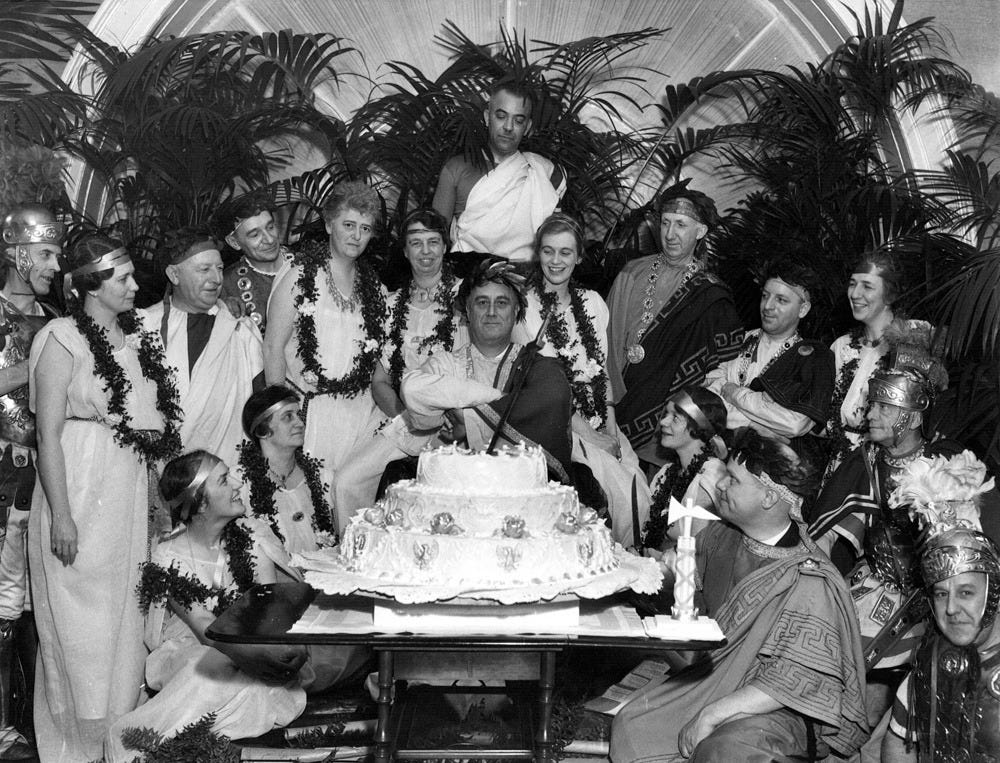
This party in 1934 had a toga theme
More famous was John F. Kennedy’s 1962 birthday bash for 15,000 of his closest friends at Madison Square Garden, where Marilyn Monroe sang happy birthday to him.
Like everything in our rorschach reality, Trump’s event was either an epic patriotic moment or a category five travesty.
“if you are an American,” declared UFC CEO Dana White, “no matter where you sit politically, tonight was just a proud night”
“This isn’t a celebration of America 250,” said Sen. Andy Kim (D-N.J.) “This is corruption on full display on the White House lawn.”
Four days later, Obama’s ceremony was plenty star studded: Tom Hanks shot pictures from the crowd as Jennifer Hudson sang, and Bono, John Legend, Bruce Springsteen, Stevie Wonder. Much about this center breaks with tradition: it is not, for starters, a presidential library, since it does not contain his documents. (They live in a digital library managed by the National Archives.) The 19 acre campus does include a wetlands walk, a Women’s Garden, a museum and media suite, an Oval Office and an NBA regulation-size basketball court. It was designed to be, “a vibrant, living celebration of community,” Obama said in his opening remarks.
Yet this celebration too was part of a powerful tradition of post-presidential image management, which matters even more in this age of short memories. Since legacy is a shared enterprise for former presidents, they tend to support one another’s efforts to polish and perfect, even when their politics diverge. Libraries allow former presidents to write their own history, elevate their triumphs, explain their setbacks, affirm their vision of power and possibility. Each was a custodian of the office, and in their post-presidential years, they protect the institution as being bigger than any individual occupant or political rivalry.
Herbert Hoover first proposed a “former presidents club” to Harry Truman at Eisenhower’s inauguration in 1953. The unlikely pair had become productive partners, first in managing the monumental post-war humanitarian relief effort, and then in re-engineering the sprawling federal government that the New Deal and war had produced.
When Hoover agreed to attend the Truman Library dedication in 1957, he joked that “one of the important jobs of our exclusive trade union is preserving libraries.” These were not just buildings: they were shrines to the institution of the Presidency, as manifest in each administration. Five years later Truman returned the favor at Hoover’s library dedication, declaring: “I feel that I am one of his closest friends, and he is one of my closest friends.”
Ever since, library openings have served as the Presidents Club’s closest equivalent to a family reunion, providing stability and continuity that transcends the often bitter quadrennial combat of presidential campaigns.
The reunion record occurred in 2013 at the dedication of George W. Bush’s library, with five Presidents attending: Carter, George H.W. Bush, Clinton, George W. Bush and Obama, who said “We’ve been called “the world’s most exclusive club” -- and we do have a pretty nice clubhouse. But the truth is, our club is more like a support group.”
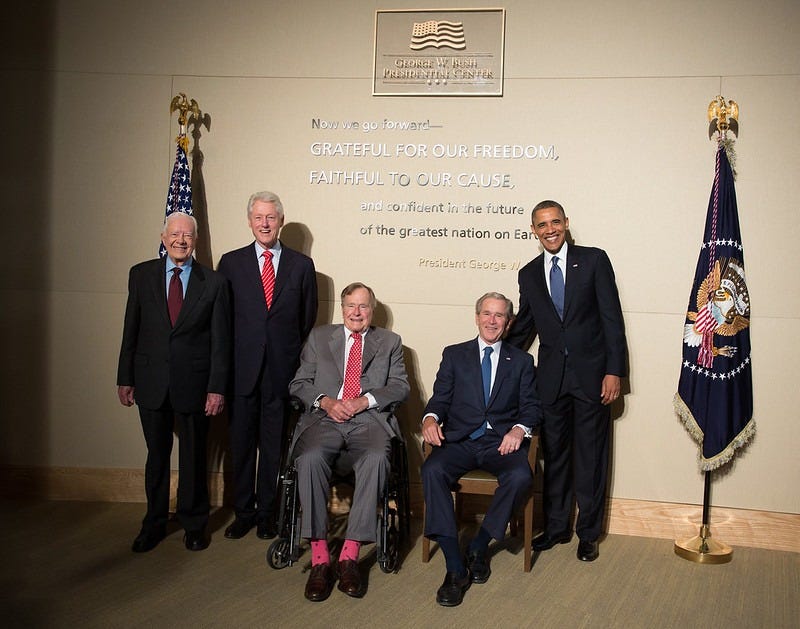
The Club at the Bush Library opening
And so it was that Presidents George W. Bush, Bill Clinton and Joe Biden all converged on Chicago for a pageant of common purpose in an age of division. President Obama made the case explicitly, calling out the “shared values that make democracy possible:” the dignity of every individual, an independent judiciary and free press, the peaceful transfer of power, character, duty, honor, accountability. “These are the values and traditions I believe in. And they are not Republican or Democratic values. They are American values we can all share regardless of party. Values every president here today, as different as we are, has tried our best to uphold.”
The image itself was the message as well, former presidents and erstwhile rivals sitting on the stage together. The contrast is not really left right, red blue. It is past vs. present, with a fierce challenge to the future. What will it take for us to throttle the feral partisan warfare, which large majorities claim to hate but mighty algorithms love at our collective peril. A Gallup survey last December found that Americans are more pessimistic about political cooperation than any other issue including the economy, international disputes, and crime.
“As unsettled as we are, people aren’t looking for perpetual anger and division,” Obama said. “They are looking for fairness and common sense and mutual respect. That deep in our gut, we want to find a way to turn towards each other again, not further away.”
This is where messages matter. Trump’s UFC spectacle was subsumed in the days that followed by one champion’s crude insult about Michelle Obama, and whether the MAGA faithful or corporate sponsors in attendance would cry foul. His fans loved it for the swagger and blasphemy that made his opponents howl.
In their remarks on this hot Chicago day, neither Michelle nor Barack Obama mentioned President Trump’s name. He was fully present in his absence—from the fraternity of presidents, from the symbols of public service, and from the message about what a 250 year old experiment truly means.
 | A guest post by
|
Thought-provoking and illustrative as always!